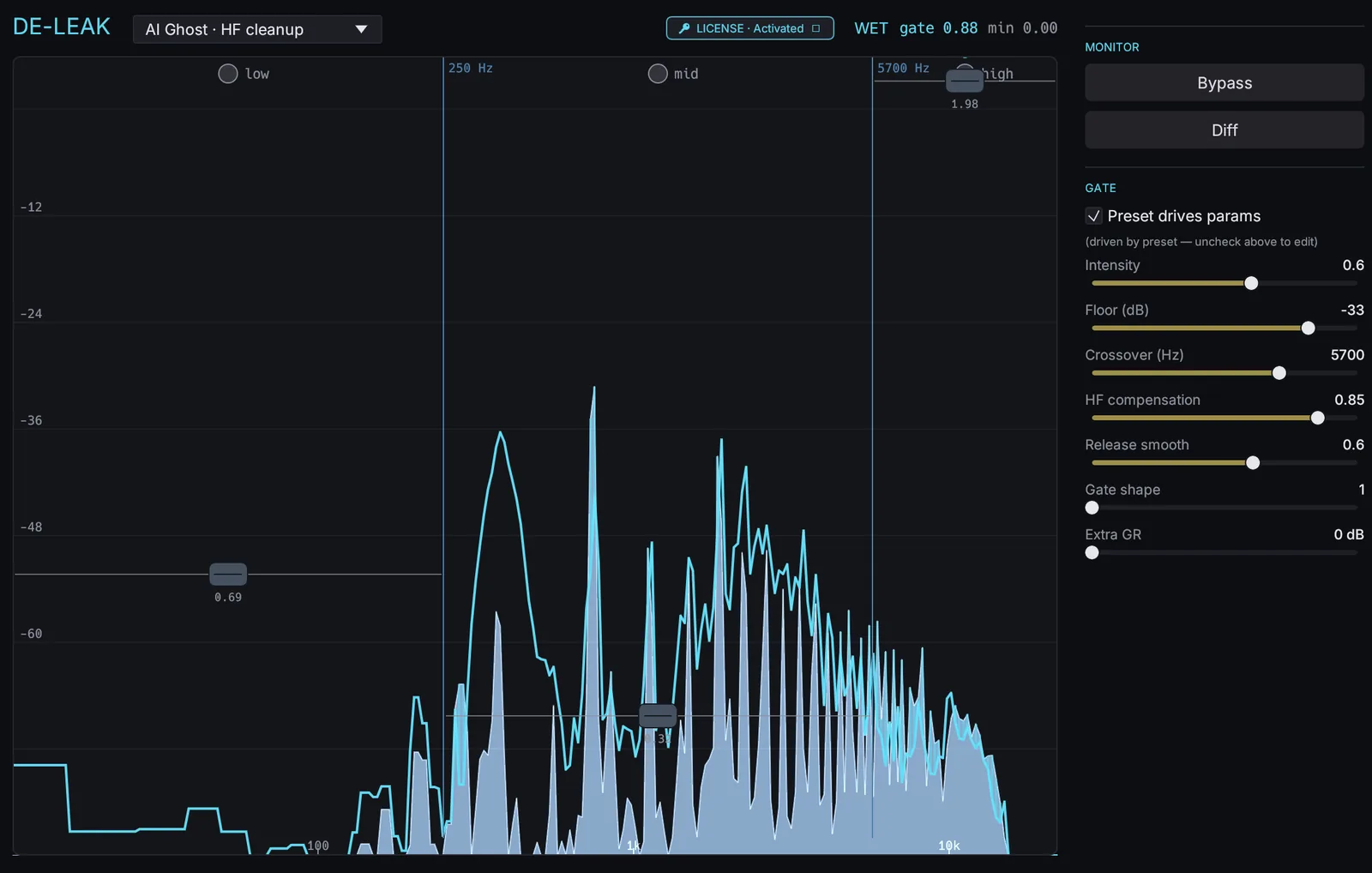
Real-time leak gate for Demucs / htdemucs stem separations. ML classifier
detects inter-stem bleeding per-frame; multiband gain removes it without
touching the music. F1 = 0.993 on MUSDB18-HQ.
Full documentation: de-leak user manual — every control, preset and workflow, with screenshots.
7 presets, tuned per stem type
Pick by what kind of stem you're cleaning. Each preset is validated against a real
corpus of Suno, Udio, and Demucs separations. Fine-tune later with the gate sliders.
Preset
Use it for
What it does
Default (Universal)
first try
Any stem when you're not sure of the source
Conservative — gain ≈ 0.94, mid protected
Vocal
Suno / Udio raw vocal stems
Preserves formant; high band aggressive on RVQ
Instrument
Drums, bass, guitar, synth — transient-heavy
False positives minimized; transients protected
Master
Full mix or master bus
Almost transparent — gain ≈ 0.98
AI Ghost
new
Suno Other / Percussion stems with 4 kHz+ ghosting
Air band cut −3.6 to −4.4 dB
AI Heavy
Coarse RVQ vocal
Gate shape 2 + extra GR 6 dB
Aggressive
Diff-mode auditioning, leak-only solo
Maximum reduction — for inspection, not mixing
Three ML models, three character profiles
All preserve vocals; they differ in how aggressively they handle reverb tails
and how much non-vocal content they let through.
Model
Trained on
Best for
Default (large_v3)
MUSDB stem leak
Conservative — real vocals always safe
Balanced (v7)
recommended
+ 859 HDF5 reverb / clean / FMA neg
Reverb suppression with vocal preservation
Aggressive Reverb (v5)
+ reverb-aware augmentation
Hard reverb tails — risk of vocal damage
Built for stem work
3 latency variants
Low-latency 23 ms for tracking. Balanced 46 ms for everyday use. Offline ±174 ms (bidirectional context) for reference parity.
134× realtime
4-minute mono input renders in ~1.8 s on M1. The classifier is light enough to run on the audio thread — no worker thread, no priming delay.
Multiband solo
Toggle low / mid / high bands independently to localize ghost noise. Solo + Diff together = audition the leak in just one band.
Wet / Dry / Diff modes
Diff outputs dry − wet — listen to exactly what's being removed. Boost the headphone +30 dB; if you hear the vocal, you're over-gating.
HF preservation
Multiband gain with frequency-aware crossover. The gate only applies below the crossover; above it you decide how much HF to protect (0 → 1.0).
Bit-exact Python parity
+137 dB SDR vs. the PyTorch reference. The plug-in is the reference implementation — no quality compromise from the Rust port.
How it works
de-leak-rt frames each STFT bin, classifies it as content vs. leak, and applies
multiband gain. Causal — no lookahead — so live monitoring works.
The classifier is a 95 K-parameter MLP (~370 KB ONNX) — it makes one decision per
STFT frame. Multiband gain is applied with HF compensation so the high-band content
you want to preserve isn't pulled down with the leak you don't.
System requirements
de-leak-rt's classifier is a 95 K-parameter MLP (~370 KB ONNX) — light enough to run
on the audio thread with no worker. Even an entry-level M1 hits 134× realtime,
so a single instance is comfortable on every supported configuration.
Requirement
Minimum
Recommended
macOS
Universal Binary — Apple Silicon (arm64) + Intel (x86_64) in one .pkg · macOS 11 (Big Sur) or later
Windows
Windows 10 x64 or later · .exe installer · VST3 + CLAP
Any — rubato resampler 8 k–384 k. Internal model runs at 44.1 kHz.
Channels
Mono / stereo (per-channel processing).
Hosts (macOS)
VST3 + CLAP — Live, Reaper, Bitwig, Studio One. Logic Pro is not supported because de-leak-rt does not ship as an Audio Unit.
Hosts (Windows)
VST3 + CLAP — Live, Reaper, Bitwig, Studio One, FL Studio
Linux
Roadmap.
FAQ
Why do I get clicks when toggling the band solo?
Fixed — solo transitions use a one-pole ramp (~30 ms half-life). If you still hear them, please report with the host and SR.
Diff + solo together — what should I hear?
Only the dry-minus-wet of the active band. If a vocal appears in the residual you're over-gating that band; back off intensity or raise HF compensation.
Offline bounce comes out silent or short.
The host needs PDC enabled. de-leak-rt reports latency = host_chunk_samples (~93 ms @ 44.1 k). Most modern DAWs handle this automatically.
Will it work on a non-44.1 kHz session?
Yes — rubato resamples 8 k to 384 k transparently. The model always runs at its native 44.1 k internally.
How does it differ from a regular noise gate?
A noise gate triggers on RMS below threshold. de-leak-rt's classifier was trained to distinguish musical content from leak per-frame — it stays open during sub-threshold content and closes during loud leak.
Hear it on real stems
Pick a stem and tap Original / De-leaked / Diff
to A/B in place. Playback is synchronized across all three — no re-buffer, no click,
no time jump. These are real source-separation outputs (Suno/Udio internal splitters, a
demucs/htdemucs re-separation of the same mixes, and a human multitrack) — not synthetic.
"De-leaked" uses de-leak-rt's strongest RT model (balanced_large_v8);
Diff plays only what the gate removed.
0:000:00
Keyboard:1 Original ·
2 De-leaked ·
3 or D Diff ·
V/H/I/F Vocal/htdemucs/Instr/Fullmix ·
Space play ·
←/→ ±5 s
What to listen for: on a vocal stem the Diff should be drum/synth/other
bleed — if you hear the lead vocal in there, the gate is over-closing (the model emits one
scalar gain per time frame, so leak that overlaps the vocal in time gets squeezed too — that's
the RT trade-off; per-bin spectral work is de-artifact's job). On instrument and
fullmix stems the Diff should be near-digital-silence — that's the protection path
holding the stem untouched. Strongest cases: First Time lead vocal, and
Suno 003 — flip its Vocal vs Vocal · htdemucs
stems to hear the engine separator and a demucs re-separation get cleaned almost identically.
Try it free for 14 days, buy when you're sold
See de-leak-rt and de-artifact on the same drum bus first — A/B against the dry source. Then download the installer for a free 14-day full trial — every preset, every parameter, no gaps. After 14 days the plug-in inserts a brief silent gap every 60 seconds until you activate.
Start the 14-day trial
14-day free trial
Default v3, Balanced v7, and Aggressive Reverb v5 all included — full quality, no gaps for 14 days. After that the plug-in inserts a brief silent gap every 60 seconds until you activate with a license key.
macOS — Apple Silicon + Intel · Windows — x86_64 · Linux — roadmap
Buy de-leak-rt
Release price — ends Sep 30
One-time purchase, three machines, free updates within v1.x. The license key arrives by email and unlocks the plug-in instantly — whether you're on day 1 of the trial or past day 14.
$99$79one-time
Try it on your next stem session
One license, all formats. Free updates within v1.x.