If your Suno track sounds metallic, watery or smeared, several AI music artifact removers now promise to fix it. We ran eight of them, from free tools like Shimmer, Deshimmer and InstaSong Desunofier to plug-ins like soothe2, RX, UNCHIRP and de-artifact, on the same recordings with frozen settings. We matched the loudness and published the audio, spectrograms and measurements so you can compare them yourself.
Disclosure: we make de-artifact, one of the tools tested, so we have a commercial interest in the outcome. The method, every measurement and lossless copies of every output are linked below.
The short answer
On the same 16 recordings, the eight tools changed the audio by very different amounts. The median change ranged from −9.85 dB (RX 10 Spectral De-noise (legacy), the most change) to −44.68 dB (Shimmer 2.3.5, the least). de-artifact measured −27.61 dB, in the same range as a plain −3 dB high-shelf EQ (−28.94 dB), which we ran as a control. More-negative numbers mean less change, not better sound.
On the two MP3-damaged files that have a lossless original, only InstaSong Desunofier (Strong) (15.32 → 11.96 dB) and UNCHIRP 1.2.0 (factory) (15.32 → 14.23 dB) moved the output closer to that original by log-spectral distance. The others, de-artifact included (15.32 → 15.46 dB), left it about the same or slightly further. By plain RMS error, which has no gain fit, every tool moved further from the original than the damaged input (−22.07 dB). No tool pushed samples to 0 dBFS.
No listening panel was run. These numbers describe how much each tool changed the sound, not which one sounds better: listen to the examples below and judge by ear.
How do AI music artifact removers change a track? Listen and compare
Choose one of the 16 shared examples, then switch between versions. The audio and its spectrogram change together, and switching keeps your playback position. Every version of an example covers the same aligned interval at the same loudness (normally −20 LUFS), with no limiter.
suno_01 · Suno · ai mix · playback target -20.00 LUFS
Selected: suno_01 / Original
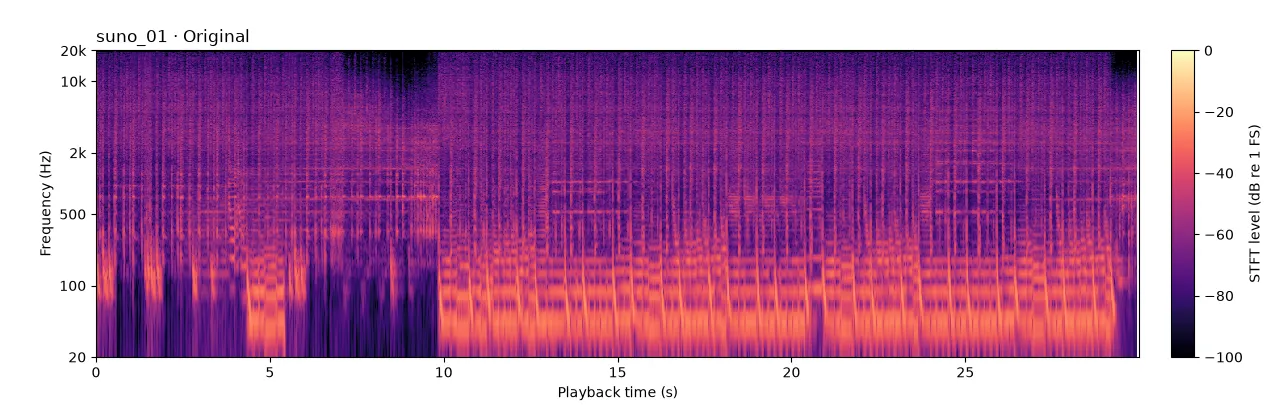
The player streams Opus at 256 kbps. All measurements and spectrograms were made on the 24-bit PCM files, and each version can be downloaded as lossless FLAC. Colour differences in a spectrogram show where energy changed, not how much of an artifact was removed. stem_04 is a near-silent stem kept because the input set was frozen before processing; it is not a useful musical example.
Which AI music artifact removers did we test?
Eight configurations: de-artifact, soothe2, RX 10 Spectral De-noise, Acon DeNoise2, Shimmer 2.3.5, Deshimmer, InstaSong Desunofier and UNCHIRP. Three controls sit alongside them: bypass, a fixed −3 dB high-shelf EQ, and Gullfoss at factory settings (Recover and Tame at zero, so it is a neutral workflow check, not a test of Gullfoss). We used installed licences and free tools. RX 10 and soothe2 are older versions than the current RX and soothe3, and the de-artifact we measured is 0.4.7; the current release is 0.4.8.
Settings were fixed on eight separate calibration tracks before any evaluation file was processed: documented restoration guidance where it exists, factory defaults otherwise, mastering off wherever a tool exposes it. No setting was tuned on evaluation outputs. New spending for the study was 0 KRW.
Product survey: what we found and what we could not measure
We searched in passes until a pass found no new product. This is a dated, bounded survey, not a complete market list. A product we could not measure was not tested and has no result here; that says nothing about how it performs.
Tools that advertise AI-music cleanup
| Product | Where it runs | Listed price, October 9, 2026 | Status |
|---|---|---|---|
| Sunofix | Cloud | 1 free account credit; additional $1 credits | Not measured: one free export; the common set would need paid credits. |
| Gloss | Local AU/VST3/standalone | GBP 39.99 plus applicable VAT | Not measured: purchase and download were not completed. |
| Shimmer | Local Python | Free on owned/controlled computers, including commercial work; source-available restrictions | Measured: 8 calibration, 48 evaluation and 4 repeat outputs. |
| Deshimmer / DeAI | Local Python DSP | Free (open source) | Measured: 8 calibration, 48 evaluation and 4 repeat outputs. |
| Humanize Mastering | Local plugin and cloud | Plugin USD 49; web recurring subscription | Not measured: the trial export is watermarked. |
| InstaSong Desunofier | Local browser DSP; no server upload per official page | Free | Measured: 8 calibration, 48 evaluation and 4 repeat outputs. |
| Suno Shimmer Remover | Cloud with stem separation | Shimmer removal: 2 tokens/run; 20 tokens USD24.99; Starter USD9.99/month | Not measured: free exports are watermarked; no paid plan was bought. |
| AI Music Doctor | Local Python | Free (open source) | Not measured: we tested on macOS and found no macOS build. |
| The Refiner | TinyRedPixel cloud; Enhanced reconstruction plus optional AI-artifact cleanup | Hobby $9/month 30 credits; Pro $29/month 75; Studio $49/month 150 | Not measured: free credits do not cover the common set. |
| Mixify AI Music Enhancer | Cloud enhancer/mastering | EUR 14/month advertised | Not measured: free previews do not cover the common set. |
| Neural Analog | Cloud and plugin/API | Free6 processing minutes/month; Pro EUR29/month; one-time1000-minute pack EUR20 | Not measured: free minutes do not cover the common set. |
| MasterForge | Not verified | Five free masters; Starter EUR4.99/month; Pro EUR9.99/month; preparation credit packs from EUR4.99 | Not measured: free masters do not cover the common set. |
General restoration and resonance tools
| Product | Where it runs | Listed price, October 9, 2026 | Status |
|---|---|---|---|
| iZotope RX | Local plugin/standalone | Existing RX10 installation measured; current RX12 price not verified from dynamic official store | Measured: 8 calibration, 48 evaluation and 4 repeat outputs. |
| oeksound soothe | Local plugin | Existing installed soothe2; current soothe3 20-day trial | Measured: 8 calibration, 48 evaluation and 4 repeat outputs. |
| Soundtheory Gullfoss | Local plugin | USD199 current official list; existing active installation measured | Measured: 8 calibration, 48 evaluation and 4 repeat outputs. |
| Acon Restoration Suite | Local plugin | Restoration Suite 2.x USD99, VAT included where applicable; existing DeNoise2 measured | Measured: 8 calibration, 48 evaluation and 4 repeat outputs. |
| Zynaptiq UNCHIRP | Local plugin | USD 269 / EUR 279 incl. 19% VAT; 30-day trial | Measured: 8 calibration, 48 evaluation and 4 repeat outputs. |
| Zynaptiq UNFILTER | Local plugin | USD269 plus applicable sales tax / EUR279 incl.19% VAT | Not measured: trial activation was not completed. |
| Steinberg SpectraLayers | Local standalone | Not verified | Not measured: no automatic repair export; manual editing is out of scope. |
Prices are as listed on each official page on October 9, 2026. de-artifact's own page listed USD 149 one-time (release price through December 31, 2026; USD 179 list) and a 14-day trial; we measured the local plug-in, not the Cloud version.
How much does each artifact remover change the audio?
The change figure is the residual after aligning each output to its input and fitting one overall gain, relative to the input, in dB. It answers "how much did this tool alter the recording?" It does not say whether the alteration removed an artifact or improved the music. The fixed high-shelf EQ shows what a simple tonal change scores.
Common 16
| Configuration | Inputs | Median change (dB) | Range (dB) | Median loudness change (LU) | Files reaching 0 dBFS |
|---|---|---|---|---|---|
| Acon DeNoise2 | 16 | -14.06 | -23.43 to -10.15 | -1.90 (n=15) | 0 |
| Bypass | 16 | -300.00 | -300.00 to -300.00 | +0.00 (n=15) | 0 |
| de-artifact 0.4.7 | 16 | -27.61 | -109.83 to -20.35 | -0.30 (n=15) | 0 |
| Deshimmer | 16 | -25.78 | -29.31 to -9.95 | -1.10 (n=15) | 0 |
| Gullfoss (neutral factory control) | 16 | -123.20 | -130.28 to -108.89 | +0.00 (n=15) | 0 |
| InstaSong Desunofier (Strong) | 16 | -20.81 | -36.41 to -0.25 | -0.10 (n=15) | 0 |
| RX 10 Spectral De-noise (legacy) | 16 | -9.85 | -19.82 to -3.40 | -2.20 (n=15) | 0 |
| Shimmer 2.3.5 | 16 | -44.68 | -87.10 to -30.84 | +0.00 (n=15) | 0 |
| soothe2 (legacy) | 16 | -23.38 | -76.99 to -16.92 | -0.50 (n=15) | 0 |
| UNCHIRP 1.2.0 (factory) | 16 | -19.00 | -23.67 to -6.43 | +0.10 (n=15) | 0 |
| −3 dB high-shelf control | 16 | -28.94 | -37.22 to -15.67 | -0.10 (n=15) | 0 |
Codec damage with a known original
Two piano recordings were damaged with fixed 64 kbps MP3 encoding, so each has a lossless original to compare against. Error is RMS error relative to the original, without a gain fit; LSD is log-spectral distance. Lower means closer to the original, for this codec and these two files only.
| Configuration | Input error (dB) | Output error (dB) | Input LSD (dB) | Output LSD (dB) |
|---|---|---|---|---|
| Acon DeNoise2 | -22.07 | -10.74 | 15.32 | 16.20 |
| Bypass | -22.07 | -22.07 | 15.32 | 15.32 |
| de-artifact 0.4.7 | -22.07 | -20.14 | 15.32 | 15.46 |
| Deshimmer | -22.07 | -13.64 | 15.32 | 15.32 |
| Gullfoss (neutral factory control) | -22.07 | -22.07 | 15.32 | 15.32 |
| InstaSong Desunofier (Strong) | -22.07 | -21.60 | 15.32 | 11.96 |
| RX 10 Spectral De-noise (legacy) | -22.07 | -7.59 | 15.32 | 15.45 |
| Shimmer 2.3.5 | -22.07 | -21.95 | 15.32 | 15.39 |
| soothe2 (legacy) | -22.07 | -15.92 | 15.32 | 15.32 |
| UNCHIRP 1.2.0 (factory) | -22.07 | -18.62 | 15.32 | 14.23 |
| −3 dB high-shelf control | -22.07 | -21.31 | 15.32 | 15.41 |
Extended 48 inputs, clean recordings, repeatability, timing and quality checks
Extended 48
| Configuration | Inputs | Median change (dB) | Range (dB) | Median loudness change (LU) | Files reaching 0 dBFS |
|---|---|---|---|---|---|
| Acon DeNoise2 | 48 | -14.46 | -29.79 to -8.67 | -1.70 (n=46) | 0 |
| Bypass | 48 | -300.00 | -300.00 to -300.00 | +0.00 (n=46) | 0 |
| de-artifact 0.4.7 | 48 | -28.27 | -109.83 to -19.64 | -0.20 (n=46) | 0 |
| Deshimmer | 48 | -23.71 | -38.19 to -5.35 | -1.25 (n=46) | 0 |
| Gullfoss (neutral factory control) | 48 | -122.34 | -130.28 to -108.89 | +0.00 (n=46) | 0 |
| InstaSong Desunofier (Strong) | 48 | -27.99 | -46.65 to -0.25 | -0.05 (n=46) | 0 |
| RX 10 Spectral De-noise (legacy) | 48 | -9.11 | -30.07 to -3.03 | -3.30 (n=46) | 0 |
| Shimmer 2.3.5 | 48 | -47.66 | -97.87 to -30.84 | +0.00 (n=46) | 0 |
| soothe2 (legacy) | 48 | -24.34 | -76.99 to -16.36 | -0.50 (n=46) | 0 |
| UNCHIRP 1.2.0 (factory) | 48 | -21.39 | -25.09 to -6.43 | -0.15 (n=46) | 0 |
| −3 dB high-shelf control | 48 | -30.47 | -43.77 to -15.67 | +0.00 (n=46) | 0 |
48 of the planned 64 inputs. Eight Udio recordings were unavailable and eight YuE2 recordings were held back because their publication rights were unresolved; these are missing samples, not failed runs, and nothing was substituted.
Clean human recordings
| Configuration | Clean inputs | Median change (dB) | Largest change (dB) |
|---|---|---|---|
| Acon DeNoise2 | 8 | -14.39 | -12.48 |
| Bypass | 8 | -300.00 | -300.00 |
| de-artifact 0.4.7 | 8 | -28.85 | -26.21 |
| Deshimmer | 8 | -11.65 | -5.35 |
| Gullfoss (neutral factory control) | 8 | -121.99 | -120.08 |
| InstaSong Desunofier (Strong) | 8 | -33.78 | -30.62 |
| RX 10 Spectral De-noise (legacy) | 8 | -9.17 | -8.38 |
| Shimmer 2.3.5 | 8 | -37.08 | -30.84 |
| soothe2 (legacy) | 8 | -23.03 | -21.98 |
| UNCHIRP 1.2.0 (factory) | 8 | -22.00 | -21.48 |
| −3 dB high-shelf control | 8 | -30.81 | -29.73 |
A small change on clean music suggests the tool leaves good audio alone. It does not prove it removes artifacts elsewhere, and a large change is a reason to listen, not proof of damage.
Repeat runs
| Configuration | Repeat comparisons | Largest aligned change (dB) | Byte-identical outputs |
|---|---|---|---|
| Acon DeNoise2 | 4 | -29.89 | 0 |
| Bypass | 4 | -300.00 | 4 |
| de-artifact 0.4.7 | 4 | -300.00 | 0 |
| Deshimmer | 4 | -300.00 | 4 |
| Gullfoss (neutral factory control) | 4 | -300.00 | 0 |
| InstaSong Desunofier (Strong) | 4 | -300.00 | 4 |
| RX 10 Spectral De-noise (legacy) | 4 | -300.00 | 0 |
| Shimmer 2.3.5 | 4 | -300.00 | 4 |
| soothe2 (legacy) | 4 | -300.00 | 0 |
| UNCHIRP 1.2.0 (factory) | 4 | -34.07 | 0 |
| −3 dB high-shelf control | 4 | -300.00 | 0 |
Two fixed files were processed three times per configuration; runs 2 and 3 are compared with run 1. −300 dB is the analyser's floor for a zero difference. Acon DeNoise2 and UNCHIRP gave slightly different output on each run; we did not identify why.
Processing time
| Configuration | Timed jobs | Median seconds per 30-second input | Timing boundary |
|---|---|---|---|
| Acon DeNoise2 | 48 | 0.526 | processor_call_seconds |
| Bypass | 48 | 0.043 | render_seconds |
| de-artifact 0.4.7 | 48 | 28.409 | processor_call_seconds |
| Deshimmer | 48 | 8.776 | render_seconds |
| Gullfoss (neutral factory control) | 48 | 1.408 | processor_call_seconds |
| InstaSong Desunofier (Strong) | 47 | 0.866 | browser-side choose-file-to-download walltime; UI overhead included; not cloud processing |
| RX 10 Spectral De-noise (legacy) | 48 | 1.092 | processor_call_seconds |
| Shimmer 2.3.5 | 48 | 5.209 | render_seconds |
| soothe2 (legacy) | 48 | 0.396 | processor_call_seconds |
| UNCHIRP 1.2.0 (factory) | 48 | 4.909 | processor_call_seconds |
| −3 dB high-shelf control | 48 | 0.206 | render_seconds |
Plug-in times cover the processing call only; browser and cloud times include their own overhead, so the rows cannot be ranked against each other as engine speed.
Quality checks
No dropouts or alignment-search boundary hits were flagged.
Tool by tool: what each remover did to the same tracks
The same figures as the tables above, one tool at a time. Gullfoss, the high-shelf EQ and bypass are controls and are left out here. A larger change means the tool did more to the recording; whether that removed artifacts or added colour is something to judge by ear in the player.
Acon DeNoise2
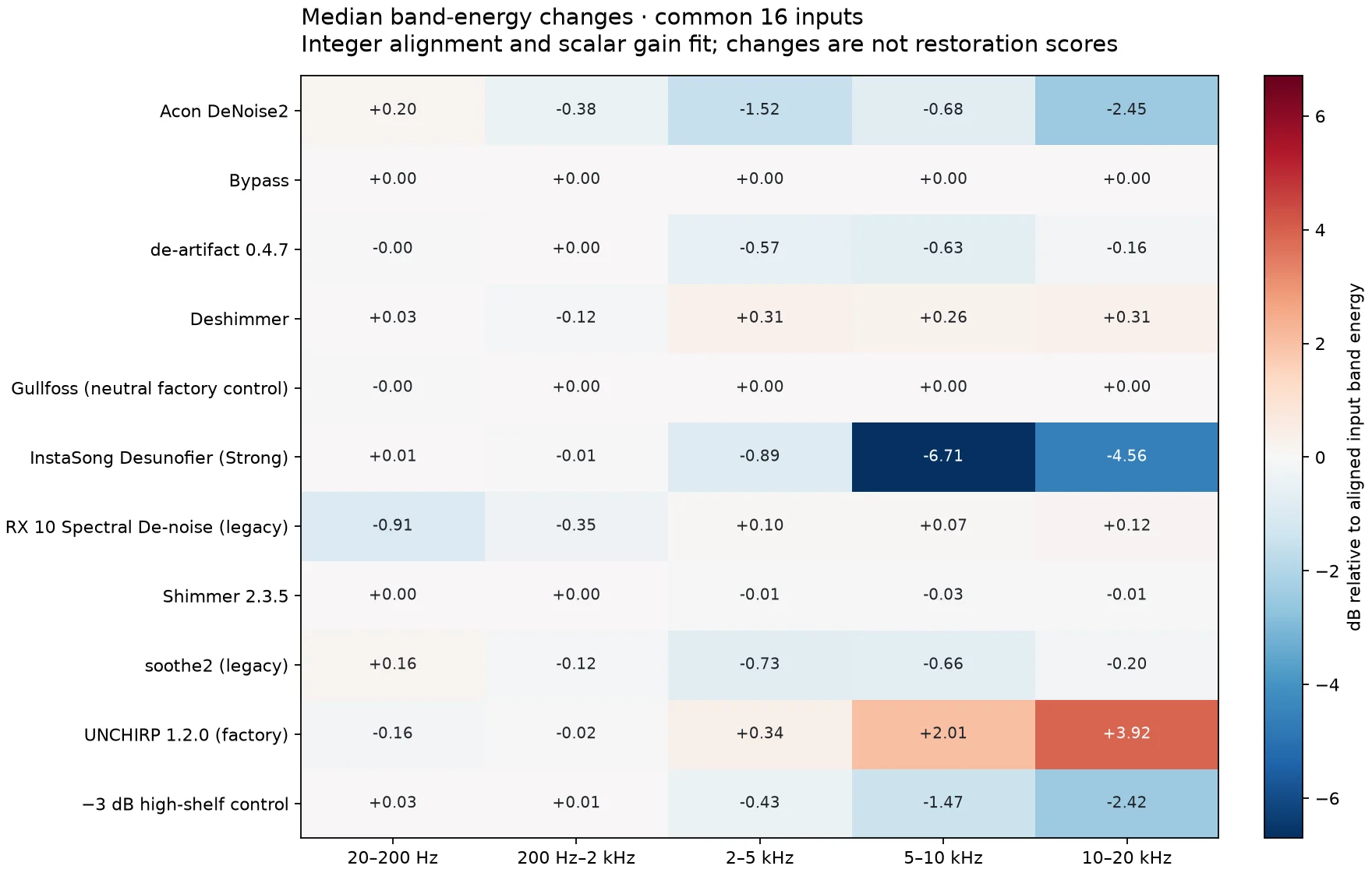
Local plugin. Listed price on October 9, 2026: Restoration Suite 2.x USD99, VAT included where applicable; existing DeNoise2 measured. On the common 16 it changed the audio by a median of −14.06 dB (range −23.43 to −10.15 dB) and moved loudness by −1.90 LU. On the two codec-damaged files, log-spectral distance to the original went from 15.32 to 16.20 dB. Median band changes, low to high: 20–200 Hz +0.04 dB, 200 Hz–2 kHz −0.35 dB, 2–5 kHz −1.38 dB, 5–10 kHz −1.08 dB, 10–20 kHz −3.05 dB.
de-artifact 0.4.7
Local plug-in (VST3, AU, CLAP) and a separate Cloud version. Listed price on October 9, 2026: USD 149 one-time release price (USD 179 list), 14-day trial. On the common 16 it changed the audio by a median of −27.61 dB (range −109.83 to −20.35 dB) and moved loudness by −0.30 LU. On the two codec-damaged files, log-spectral distance to the original went from 15.32 to 15.46 dB. Median band changes, low to high: 20–200 Hz −0.04 dB, 200 Hz–2 kHz +0.01 dB, 2–5 kHz −0.66 dB, 5–10 kHz −0.82 dB, 10–20 kHz −0.20 dB.
Deshimmer
Local Python DSP. Listed price on October 9, 2026: Free (open source). On the common 16 it changed the audio by a median of −25.78 dB (range −29.31 to −9.95 dB) and moved loudness by −1.10 LU. On the two codec-damaged files, log-spectral distance to the original went from 15.32 to 15.32 dB. Median band changes, low to high: 20–200 Hz +0.03 dB, 200 Hz–2 kHz −0.15 dB, 2–5 kHz +0.49 dB, 5–10 kHz +0.69 dB, 10–20 kHz +0.57 dB.
InstaSong Desunofier (Strong)
Local browser DSP; no server upload per official page. Listed price on October 9, 2026: Free. On the common 16 it changed the audio by a median of −20.81 dB (range −36.41 to −0.25 dB) and moved loudness by −0.10 LU. On the two codec-damaged files, log-spectral distance to the original went from 15.32 to 11.96 dB. Median band changes, low to high: 20–200 Hz +0.01 dB, 200 Hz–2 kHz −0.00 dB, 2–5 kHz −0.60 dB, 5–10 kHz −6.04 dB, 10–20 kHz −4.42 dB.
RX 10 Spectral De-noise (legacy)
Local plugin/standalone. Listed price on October 9, 2026: Existing RX10 installation measured; current RX12 price not verified from dynamic official store. On the common 16 it changed the audio by a median of −9.85 dB (range −19.82 to −3.40 dB) and moved loudness by −2.20 LU. On the two codec-damaged files, log-spectral distance to the original went from 15.32 to 15.45 dB. Median band changes, low to high: 20–200 Hz −0.65 dB, 200 Hz–2 kHz −0.37 dB, 2–5 kHz +1.28 dB, 5–10 kHz +1.48 dB, 10–20 kHz +0.96 dB.
Shimmer 2.3.5
Local Python. Listed price on October 9, 2026: Free on owned/controlled computers, including commercial work; source-available restrictions. On the common 16 it changed the audio by a median of −44.68 dB (range −87.10 to −30.84 dB) and moved loudness by +0.00 LU. On the two codec-damaged files, log-spectral distance to the original went from 15.32 to 15.39 dB. Median band changes, low to high: 20–200 Hz +0.00 dB, 200 Hz–2 kHz +0.00 dB, 2–5 kHz −0.01 dB, 5–10 kHz −0.02 dB, 10–20 kHz −0.01 dB.
soothe2 (legacy)
Local plugin. Listed price on October 9, 2026: Existing installed soothe2; current soothe3 20-day trial. On the common 16 it changed the audio by a median of −23.38 dB (range −76.99 to −16.92 dB) and moved loudness by −0.50 LU. On the two codec-damaged files, log-spectral distance to the original went from 15.32 to 15.32 dB. Median band changes, low to high: 20–200 Hz +0.21 dB, 200 Hz–2 kHz −0.07 dB, 2–5 kHz −0.47 dB, 5–10 kHz −0.12 dB, 10–20 kHz +0.04 dB.
UNCHIRP 1.2.0 (factory)
Local plugin. Listed price on October 9, 2026: USD 269 / EUR 279 incl. 19% VAT; 30-day trial. On the common 16 it changed the audio by a median of −19.00 dB (range −23.67 to −6.43 dB) and moved loudness by +0.10 LU. On the two codec-damaged files, log-spectral distance to the original went from 15.32 to 14.23 dB. Median band changes, low to high: 20–200 Hz −0.06 dB, 200 Hz–2 kHz −0.02 dB, 2–5 kHz −0.65 dB, 5–10 kHz −0.89 dB, 10–20 kHz +2.42 dB.
How was the comparison run?
The evaluation set has 48 distinct sources: 16 AI full mixes (8 Suno, 8 ACE-Step), 16 separated stems, 8 codec-damaged recordings and 8 clean human recordings. The common 16 used in the player is 8 AI mixes (4 Suno, 4 ACE-Step), 4 stems, 2 codec files and 2 clean recordings. Every input is 30 seconds of 44.1 kHz stereo PCM24.
Suno files come from our own paid account; ACE-Step tracks were generated from text under the model card's commercial-output terms. Clean and codec music is Kimiko Ishizaka's CC0 Open Goldberg Variations, so the human material is solo piano and does not cover other genres. Some Suno sources were lossy exports, and converting them to WAV does not restore what was lost.
The analyser was checked first against known cases: bypass, a known gain, a 137-sample delay, a known EQ, clipping and a near-silent input. It measures alignment, level, loudness, true peak, clipping, silence, stereo correlation, band energy and time-resolved change. Listening copies share one integer-aligned interval and one scalar gain per file; if any version would exceed −1 dBTP, the whole example set uses a lower target instead of a limiter. Spectrograms use a 4,096-sample Hann STFT with a 1,024-sample hop on those copies.
What this study does not tell you: which tool sounds best, what share of artifacts any tool removed, or whether listeners prefer one result. Those need a listening test, which we did not run.
Data and downloads
- Per-file measurements (CSV) and full measurements with repeats (JSON)
- Source, rights and hash manifest
- Listening-copy crop, gain and hashes and spectrogram method and hashes
- Product survey
- Methods package: analyser code, frozen settings and data
Vendor software, model weights and licence details are not redistributed; reproducing a tool's output needs your own installation and the frozen settings in the package.
Rights references: Suno commercial use, ACE-Step model card, Open Goldberg Variations.
Related reading
- What is an audio artifact? The kinds of damage these tools try to remove.
- Suno metal artifacts: fizzy cymbals and guitars, and how to fix them.
- WAV vs MP3 for AI music, and why a lossy export limits any cleanup.
- How to clean a separated vocal stem.
- de-artifact walkthrough: what to listen for, chapter by chapter.
- de-artifact vs artefactFX: two different goals.
Want to try an AI music artifact remover on your own Suno track? de-artifact has a 14-day trial.
FAQ
What is the best AI music artifact remover?
This comparison does not name one. We measured how much eight tools changed the same Suno, ACE-Step and human recordings and how close codec-damaged files came to their originals, but we did not run a listening test. Use the matched-loudness player to judge by ear on the examples closest to your material.
How were the tools set up?
Settings were fixed on eight separate calibration tracks before any evaluation file was processed: documented restoration guidance where a vendor gives it, factory defaults otherwise, and mastering off wherever a tool exposes it. No setting was tuned on the evaluation outputs.
Why is the player audio Opus instead of WAV?
Streaming 194 lossless files would be slow, so the player uses Opus at 256 kbps. All measurements and spectrograms were made on the 24-bit PCM files, and every version can be downloaded as lossless FLAC from the player.
Is there a free Suno shimmer remover?
Yes. Of the tools we measured, Shimmer, Deshimmer and InstaSong Desunofier were free to use as of October 9, 2026, and all three ran on the full common set. Shimmer and Deshimmer run locally in Python; Desunofier runs in the browser. Their measured changes are in the tool-by-tool section.
How do I remove artifacts from a Suno song?
Run the track through an artifact remover, then compare the result with the original at matched loudness. Start from the best-quality export you have, because a lossy MP3 has already lost information no tool can restore. The examples in this comparison let you hear what each tool does before you commit to one.
Does an artifact remover change the rest of the mix?
Every tool changed clean human piano recordings too, by a median of about 9 to 37 dB below the input depending on the tool. Small changes on clean material suggest a tool leaves good audio alone. A large change is a reason to listen closely, not proof of damage.
Why are some tools missing?
We measured only tools we could run on the full common set with an export we were allowed to use. Products limited by watermarked trials, free credits that did not cover the set, or no macOS build are listed in the survey as not measured, which says nothing about how they perform.